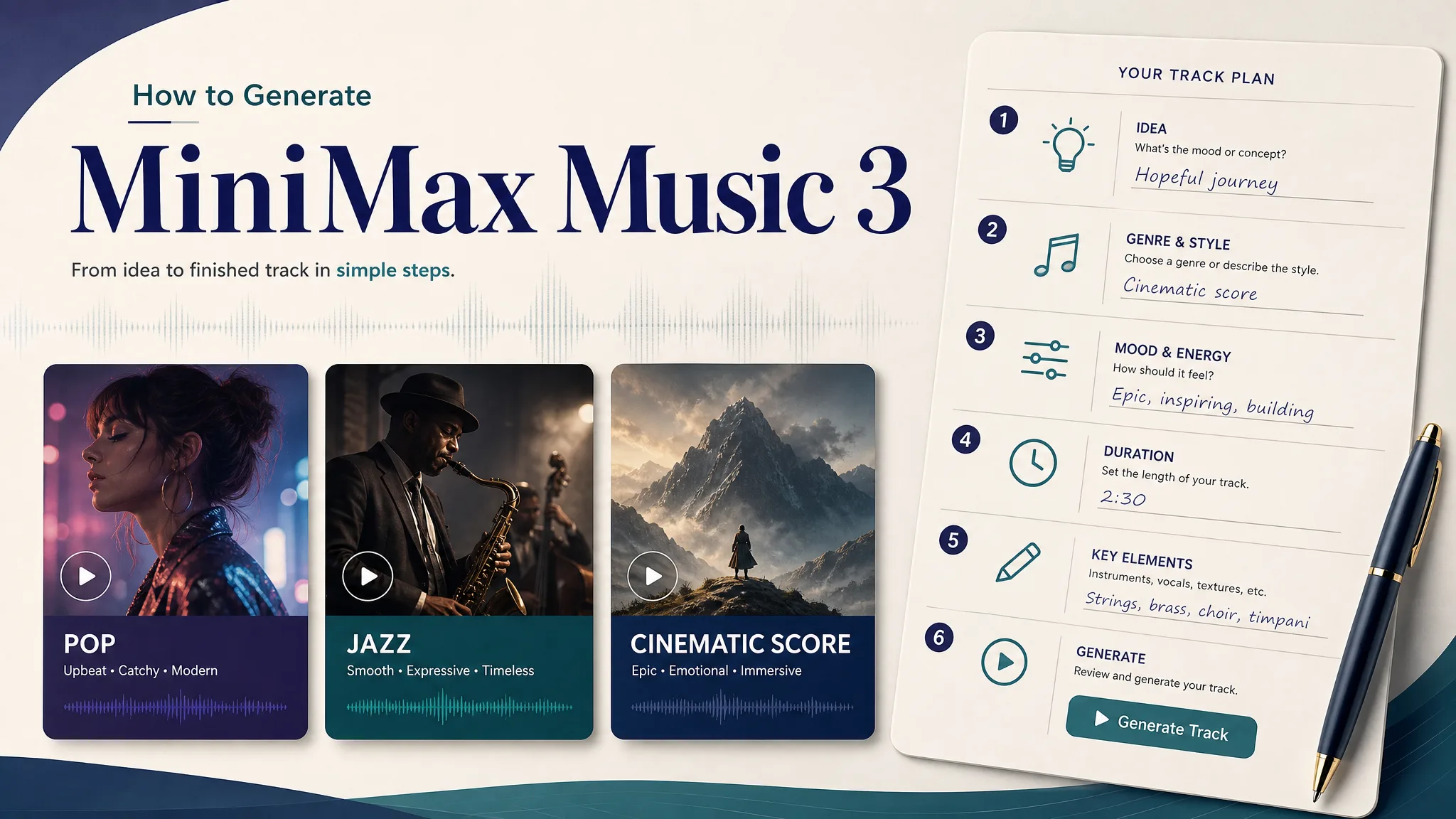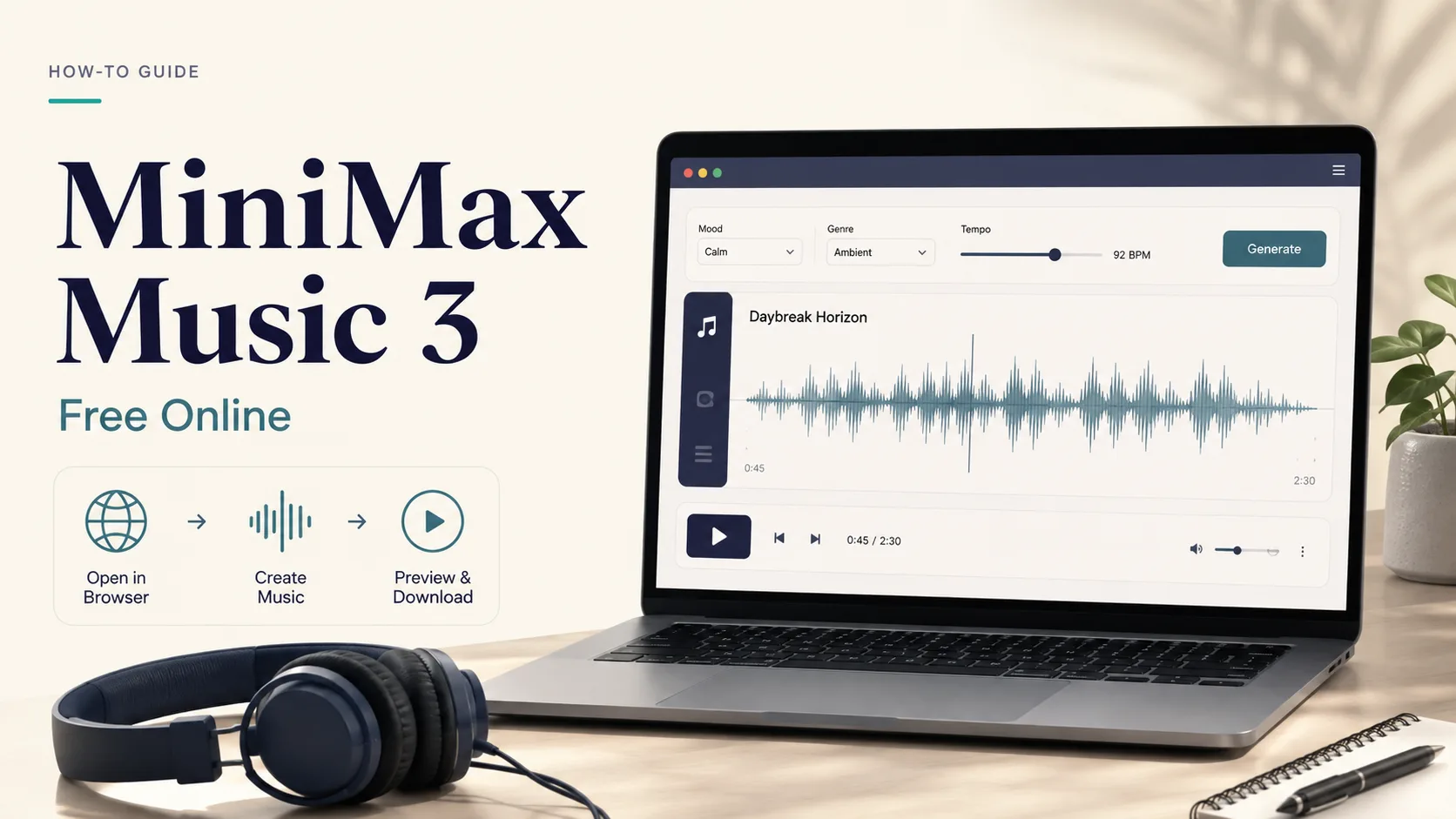
TLDR
- MiniMax Music 3 (open-weight release 13 August 2026): full songs with lyrics + a music description; vendor claim up to five minutes; Structured Caption (global metadata, vocal details, arrangement) plus lyric tags such as
[Verse]and[Chorus]; 32 kHz, 16-bit stereo WAV (MiniMax blog; model card). - Suno-style consumer apps: closed, prompt-first, tuned for a catchy one-shot song. Useful when you want a hook fast and do not need downloadable weights or a three-part caption. This article does not treat any closed app as a lab score.
- Lyria 3: Google’s playground / Pro split for custom tracks from text or image (Gemini).
- ACE-Step 1.5: local open-source alternative that official materials pitch for consumer hardware and short train-your-style loops (ACE-Step 1.5).
- On this site: hear official MiniMax Music 3 records first on the homepage, then run the same brief in the workspace. One run is 20 credits; signup grants 20 credits.
Key Takeaways
- Music 3 is built as a complete song, not a loop. Official docs describe intro, verse, pre-chorus, chorus, bridge, instrumental break, and outro in one generation, with a vendor ceiling of about five minutes (model card; ComfyUI tutorial).
- Control is the product hook. MiniMax replaced a single global label with Structured Captions that track genre, tempo, key, emotional contour, instrument entry/exit, and section-level vocal changes (MiniMax blog).
- Lyric tags are executable structure.
[Intro],[Verse],[Pre-Chorus],[Chorus],[Post-Chorus],[Bridge],[Instrumental],[Solo], and[Outro]belong on their own lines (model card; ComfyUI). - Open weights are real, and they are not Apache 2.0. Weights ship under the MiniMax-Music3 Community License. Commercial UIs must display “MiniMax-Music3”; yearly revenue above USD 20 million needs written authorization. This license is not the MiniMax H3 territorial carve-out (LICENSE).
- Local and browser are different jobs. Full-precision local inference is documented around 24 GB VRAM; layer streaming can fit about 8 GB at a speed cost (model card). ComfyUI 0.33.0+ has a native Text-to-Music template (ComfyUI blog).
- This website is an independent listening desk + workspace, not MiniMax. Official demo songs such as Feel Alive (~2:51) and In the Way (~2:50) play on the homepage. Do not read the vendor “five minutes” claim as a promise for every hosted run here.
Head-to-head: public axes (not a ranking)
Read this table in 30 seconds. Cells are public positioning, not a blind listening test.
| Axis (your job) | MiniMax Music 3 | Suno-style consumer app | Lyria 3 (Google) | ACE-Step 1.5 | | --- | --- | --- | --- | --- | | Primary public pitch | Open-weight, production-ready full song from concept + lyrics (MiniMax blog) | Closed consumer song maker: simple prompt, catchy vocal track | High-fidelity tracks from text or image in the Gemini family (Gemini) | Local open-source foundation model for consumer hardware (ACE-Step 1.5) | | Weights | Downloadable on Hugging Face (model card) | Closed | Closed hosted | Open (Ace-Step1.5) | | How you steer | Structured Caption (global / vocal / arrangement) + lyric section tags (MiniMax blog) | Short style prompt + lyrics in the consumer UI | Text or image prompt; Gemini playground vs Pro split (Gemini) | Text prompt + local workflow / LoRA personalization in official materials (ACE-Step 1.5) | | Duration narrative | Vendor: up to five minutes / ~300 s upper bound in documented runtimes (model card; ComfyUI) | Closed-app limits vary by plan; not scored here | Official page does not publish a single global max we will invent | Official materials emphasize fast full-song local renders, not a five-minute Music 3 claim | | Audio file MiniMax describes | 32 kHz, 16-bit stereo WAV (model card) | Host-dependent | Host-dependent | Local export in the ACE-Step toolchain | | Local floor (documented) | ~24 GB full precision; ~8 GB with layer streaming (model card) | N/A (closed app) | N/A | Official 1.5 write-up: local on consumer GPUs, turbo path under 4 GB VRAM (ACE-Step 1.5) | | License headline | MiniMax-Music3 Community License; UI credit + $20M authorization clause (LICENSE) | Vendor terms of the closed app | Google product terms | Open-source project license on the official repo | | Try path on this product | Official demos on the homepage; generate on AI Music | Not hosted here | Not hosted here | Not hosted here |
How to use the table: if the brief is “I already wrote verses and I care what the bridge does,” weight Music 3’s caption + tags. If the brief is “give me a hook in one box,” a consumer song app is the search people actually run. If the brief is “stay inside Google’s stack,” start from Lyria 3. If the brief is “LoRA on a small GPU,” read ACE-Step 1.5.
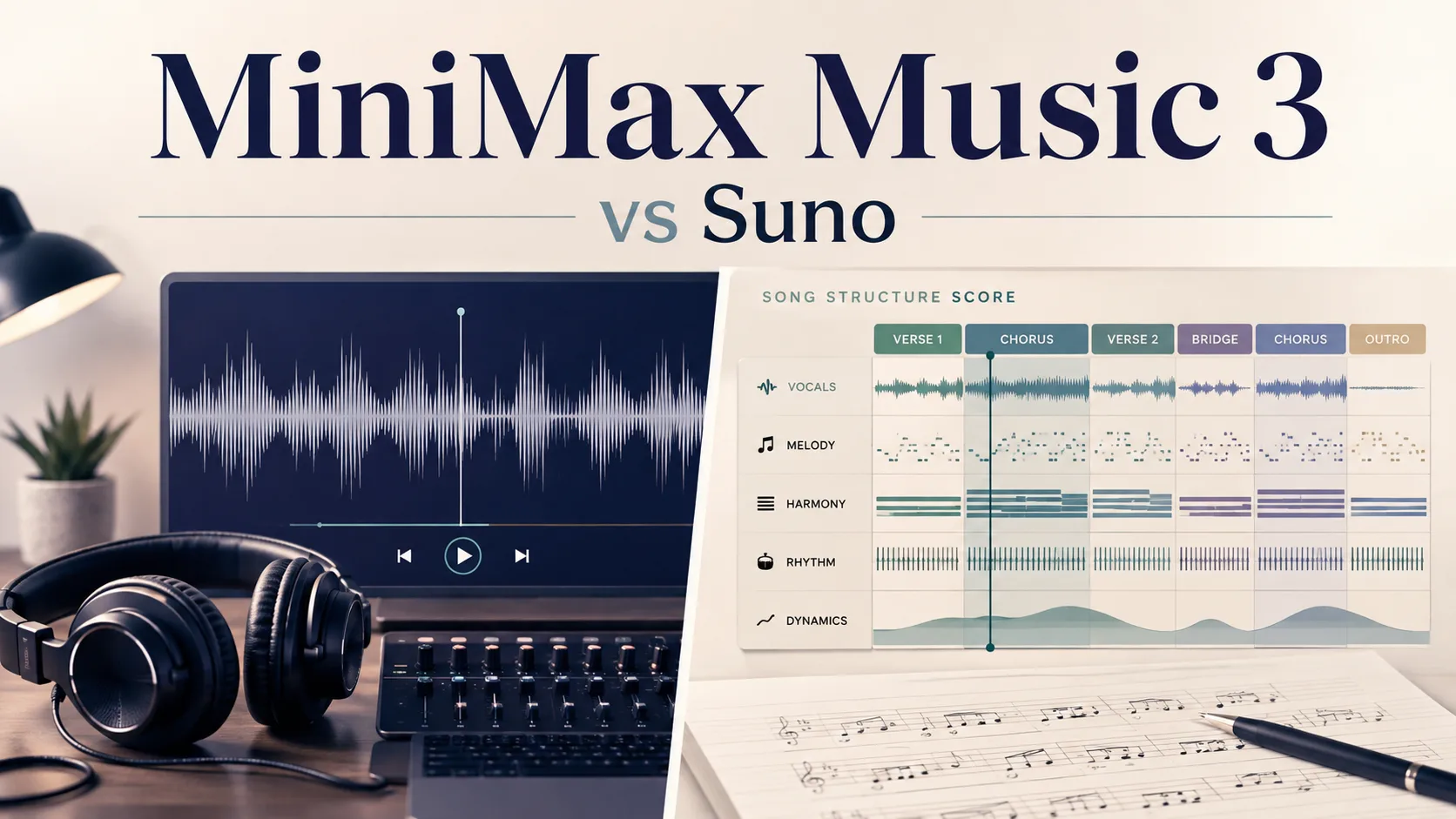
Criteria, not crowns · editorial cover for this comparison · generated for MiniMax Music 3 blog
Timeline (one open-weight week)
| Date | Event | Source | | --- | --- | --- | | 2026-08-13 | MiniMax publishes Music 3.0 as an open-weight, production-ready music model | MiniMax blog; official X post | | 2026-08-13 | Weights and docs on Hugging Face; public demo page | MiniMaxAI/MiniMax-Music3; demo | | 2026-08-13 | ComfyUI native Text-to-Music workflow (0.33.0+) | ComfyUI blog; tutorial | | Lineage | Music 3 Hybrid-LM: 8B Global LLM (Qwen3-8B init) + 0.6B Local LLM + Flow Matching + Flow-VAE | model card | | Nearby open stack | ACE-Step 1.5 (2026-04 XL series in the official changelog) remains the lightweight local contrast | ACE-Step 1.5 |
Shared vocabulary (“full song,” “vocals,” “lyrics”) does not imply the same mix, the same Mandarin brief, or the same license.
Scenario winners (if / then)
1. You already have verses and you care what the chorus does
If the words exist and the failure mode is “the hook never comes back,” then Music 3’s lyric tags plus a Structured Caption are the documented control surface (MiniMax blog).
On this site: play In the Way on the homepage for a chorus that returns, then paste your lyric sheet in the workspace.
2. You want a catchy one-shot and you will not write a caption
If you only have a mood line and you want the app to invent the rest, then a Suno-style consumer box matches that search. Music 3 can still take a short description—the official Prompt Enhancement / caption-rewriter skill exists because a one-line vibe is not the native control language (model card; GitHub skill).
On this site: start from Prompt A below, not from an empty “make it epic.”
3. Mandarin, short-drama OST, or a singer-first ballad
If the brief is Chinese lyric or a tender vocal in front of guzheng / room piano, then weight Music 3: official samples include a Shanghai jazz / soul cut and a warm Mandarin ballad (MiniMax blog; demo).
On this site: listen first, then use lyrics mode in the workspace.
4. Podcast bed, trailer, or a singer-free loop
If a vocal would fight the host, then ask for an instrumental and describe groove, bass, and how loud the drums should stay. Music 3 documents an instrumental path in the caption / tag set (ComfyUI).
On this site: switch to instrumental mode and run Prompt C.
5. Local GPU, LoRA, or “no vendor cloud”
If the job is downloadable weights on your machine, then compare Music 3 local (24 GB comfortable, 8 GB possible) with ACE-Step 1.5 on smaller cards (model card; ACE-Step 1.5).
On this site: skip the installer. Hear the official records, then generate in the browser workspace.
What We Know vs. What We Don’t
| We know (sourced) | We don’t know / won’t claim | | --- | --- | | Music 3 open-weight launch 2026-08-13 (MiniMax blog; X) | That Music 3 beats every Suno version on catchiness, mix polish, or English pop hooks | | Vendor duration claim up to five minutes; ComfyUI template default is often 60 seconds, max about 300 seconds (ComfyUI) | That every hosted run on this website is a five-minute official Music 3 render | | Structured Caption + lyric tags are the official steering language (MiniMax blog) | That tags are a hard DAW guarantee of tempo, key, or exact instrument list (model card lists this as a limitation) | | Community License, UI credit, $20M clause (LICENSE) | A blanket “royalty-free / commercially cleared” stamp on every output | | Official demo songs on the homepage sit around 2:47–2:52 | A permanent global ranking versus Lyria 3 or ACE-Step on every genre | | This product: 20 credits per run, 20 credits on signup | Cross-channel dollar-per-song shopping tables |
How to evaluate on this site (same-prompt protocol)
- Play one official record on the homepage—Feel Alive for vocal-forward R&B, In the Way for a returning chorus, The Real Man for a loud band.
- Open the MiniMax Music 3 workspace.
- Run Prompt A, B, and C unchanged (change only names you truly own).
- Score each take 0–2 on five axes: structure, lyric hold, vocal fit, arrangement clarity, usable ending.
- Keep anything ≥7/10. Rewrite only the failing line—do not throw the whole brief away.
- If you later compare a closed song app, reuse the exact same lyrics and checklist.
Prompt A — pop chorus that has to return
Genre: bright power pop. BPM: 112. Key: E-flat major.
Nostalgic verses, a shouted-friendly chorus that must repeat, clear female mezzo, punchy drums, wide guitars, polished modern mix.

[Verse]
We were the kind who never stayed in one place
Running through the city with the wind in our face
[Pre-Chorus]
I still scroll back just to see your name
[Chorus]
Forever friends we promised it one day
Guess forever is quicker than we thought it would be
[Verse]
Now you are a highlight in a story I outgrew
[Chorus]
Forever friends we promised it one day
The beat keeps moving and I will be okay
[Outro]
Even if our forever only lasted one day
Prompt B — Mandarin ballad, singer in front
Warm Mandarin pop / traditional Chinese ballad, 74 BPM, A-flat major.
Tender verse into a celebratory chorus. Mature male baritone-tenor, delicate guzheng, soft strings, gentle acoustic textures, natural live-room sound.

[Verse]
屋檐下青苔长
木窗边月影扬
[Chorus]
岁月如歌 歌声悠长
我们牵手走过风霜
[Verse]
摇椅轻晃夕阳下
旧相册笑容如花
[Chorus]
岁月如歌 歌声悠长
一壶茶温暖了心房
[Outro]
人间烟火 平淡无瑕
Prompt C — instrumental bed under speech
Instrumental only. Late-night lo-fi chillhop, 82 BPM, dusty Rhodes, upright bass, brushed drums that stay under a spoken podcast. No singer, no hook vocal, no crowd, no riser that eats dialogue. Two-minute bed with a soft ending, not a hard cutoff.
[Instrumental]
[Outro]Decision rule (one sentence)
Choose MiniMax Music 3 on this site when you will listen to an official demo first and then steer a prompt, a lyric sheet, or an instrumental bed in the workspace—especially when structure, Mandarin, or a singer-in-front mix is the job.
Treat a Suno-style consumer app as a different job when you only want a catchy one-shot and you will not write tags. Treat Lyria 3 as the Google-stack option (Gemini). Treat ACE-Step 1.5 as the small-GPU local option (ACE-Step 1.5). Still stress-test the brief here so a soft lyric does not get blamed on the model.
FAQ
Is MiniMax Music 3 better than Suno?
Not as a universal rank. Music 3’s public story is open weights + structured control + long-form song. Suno-style apps win the “one box, catchy vocal” search. Better = fits the job after you listen.
Can MiniMax Music 3 really make a five-minute song?
That is the vendor claim and the documented ComfyUI upper bound (~300 seconds) (model card; ComfyUI). Official demo records on this homepage are about three minutes. Do not assume every browser run here is a five-minute render.
Do I need a 24 GB GPU to try MiniMax Music 3?
No. Local full precision is documented around 24 GB; 8 GB is possible with offload (model card). This website runs in the browser: homepage to listen, workspace to generate.
What is a Structured Caption?
Three blocks MiniMax recommends: Global Metadata (genre, BPM, key, emotion, scene), Vocal Details (gender, timbre, harmony, effects), Arrangement (instruments and how they change by section) (model card).
Can I paste my own lyrics?
Yes. Use lyrics mode and put section tags on their own lines. Music 3 is documented to treat those tags as structure, not decoration (ComfyUI).
Is this website MiniMax official?
No. minimaxmusic3.org is an independent product. Official research lives on the MiniMax blog and Hugging Face. We host official public demo audio so you can hear a reference before you spend credits.
How do credits work here?
One music run is 20 credits. Signup grants 20 credits, so the first song is covered. Extra songs use a one-time pack. Failed runs refund credits. This article does not compare other companies’ price lists.
Where should I start if I only have a mood?
Play a demo that matches the mood, then run Prompt A (pop) or Prompt C (bed). Add BPM, who sings, and one instrument. Short and concrete beats a novel.
What about Lyria 3 and ACE-Step?
Lyria 3 is Google’s hosted music surface (Gemini). ACE-Step 1.5 is the lightweight local open-source contrast (ACE-Step 1.5). Neither is generated on this site.
Can I use a generated song commercially?
Paid credit packs on this site include commercial use under our legal pages. The signup trial song is for personal testing. MiniMax’s Community License is a separate contract if you self-host the weights (LICENSE). Nothing here is a blanket rights clearance.
Should I compare prices across platforms here?
No. Decide on job fit and keeper rate, then price on the surface you actually ship from.
About Rowan Hale
Rowan Hale is an AI music model analyst who tracks MiniMax audio releases and turns public launch claims into clear listen-then-generate paths on MiniMax Music 3.